Supply Chain Insights
Smarter operating models can potentially make long-haul trucking with bigger trucks more efficient. Can Power-only trucking be a game-changer?

Taslima Khan
5 min read
Key takeaways:
Power-only trucking model allows a drop and hook operation, eliminating hours of waiting time and hence solving truck detention.
Tractor-trailers can transport nearly 70% more volume in a single trip, thus leading to fewer truck trips required and better fuel consumption per tonne of freight.
Interchangeability of trailers allows drivers to swap loaded units at hopping hubs, ensuring continuous freight movement while providing drivers with proper rest.
——
Globally, large trucks, particularly the 40-foot tractor trailers are the backbone of long haul trucking for moving cargo beyond 500 kilometres. India is now at the cusp of a similar transformation since the conditions for wider adoption are rapidly falling into place- massive investments in expressways and high-speed freight corridors and the expansion of modern warehousing. Yet the real innovation is not the truck itself. It is the operating model that keeps these high-value assets moving.
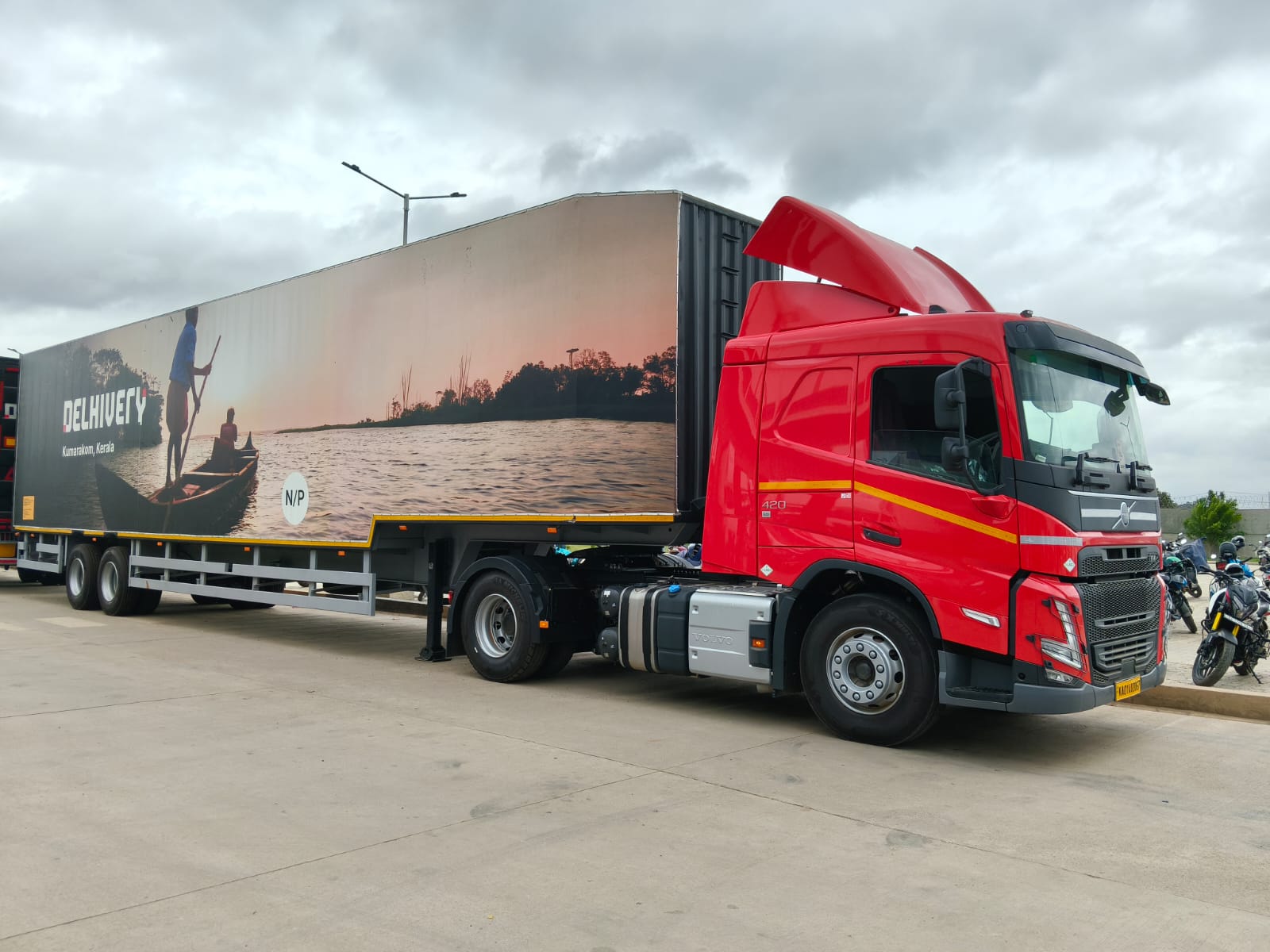
Tractor-trailers are heavy-duty commercial vehicles split into two distinct parts: a motorized towing engine (the tractor) and a detachable cargo carrier (the trailer). Unlike a standard rigid truck where the engine and cargo box are permanently built onto a single metal frame, a tractor-trailer uses a specialized coupling mechanism to lock the two halves together. These trucks can carry huge volumes of cargo between hubs or from factory to warehouses and vice-versa. Consider this: on a Delhi-Mumbai route, a 32-foot multi-axle rigid truck may consume approximately 300 litres of fuel, while a tractor-trailer may consume around 375 litres, which is roughly 25–30% more fuel. However, a tractor-trailer can transport nearly 70% more volume in a single trip, thus leading to fewer truck trips required and better fuel consumption per tonne of freight.
For logistics companies, a key challenge is to make the most of these expensive assets, costing INR 50 lakh plus. They need to ideally run for 20 hours per day and cover between 700 to 900 kilometres daily in order to realise their full potential. But the same is challenging because of multiple factors, the biggest being detention of trucks which entails trucks waiting for loading and unloading at shipper locations.
The answer to these worries lies in re-thinking the operating model.
Tractor Trailers: Unlocking Value
Delhivery has been running tractor trailers since 2019 with over 1000 tractors and 1400 trailers, operating through a combination of owned and partner-managed assets dedicated to the network.
Today, approximately 80% of Delhivery's trucking capacity is served by tractor-trailers, reflecting the company's confidence in this operating model. As a result, fuel consumption per carton, kilogram or cubic foot is substantially lower. The same principle applies to driver costs, maintenance and other operating expenses, making them more economical over their lifecycle.
Registering tractors and trailers independently has also allowed the company to invest in ideas like the Road Trains which are mega trucks having the capacity to haul about 50% more volume than a standard tractor-trailer.
Our experience with these big trucks has reinforced an important lesson: the future of long-haul freight in India will depend on creating a vibrant Power-Only trucking ecosystem.
Under this model, trailers and tractors become independent assets, allowing interchangeability of tractors and trailers. While logistics companies own the powered tractor units and supply drivers, shippers or consignors who own the cargo and need to transport it, invest in their trailers. The driver brings the tractor to the pickup location, hooks up to a pre-loaded trailer, hauls it to the destination, drops it there, and moves immediately to the next assignment.
Shubhkriti, Senior Vice President, Owned Fleet Operations at Delhivery explains:
“We have taken step one, by owning trailers and registering them independently. In a small way, we have also initiated Power-Only trucking with independently registered tractors. A large set of trailers being owned by consignors and a separate diverse tractor network comprising all kinds of hauliers or transporters, big and small, can create a flourishing ecosystem.”
The implications extend well beyond operational efficiency.
Solving Truck Detention
The Power-only model offers an effective solution to one of logistics industry’s oldest problems: detention. Across the industry, trucks routinely spend hours, and sometimes days, waiting to be loaded or unloaded. During this period, both the driver and the vehicle remain unproductive.
The power-only model on the other hand, allows a drop and hook operation, eliminating hours of waiting time. “Instead of tractors waiting at customer locations, they remain on the road generating productive kilometres. That improves tractor utilisation, reduces turnaround time, and allows us to build a far more agile and scalable line-haul network,” says Shubhkriti.
The Power-only ecosystem naturally supports relay trucking, enabling drivers to hand over trailers at designated interchange points rather than completing multi-day journeys themselves. This leads to better quality of life for truck drivers- an increasingly important consideration as the industry seeks to attract and retain skilled drivers.
We asked Sonu Ali, a driver working with Delhivery for the past three years, how this helps? This is what he has to say:
“In my experience, trailer interchangeability is extremely beneficial. At every hopping hub, I can simply drop off my loaded trailer, hook up to another loaded trailer, and continue towards the next destination. It allows us to get proper rest while the freight keeps moving, and then plan for the next available connection.” (translated into English from Hindi)
At Delhivery, the challenges posed by detention are mitigated because loading and unloading largely take place within our own facilities, where operational control helps minimise delays. Yet weather disruptions, labour shortages and other unforeseen events remain an unavoidable reality in freight operations.
There is another missing piece in the tractor-trailer ecosystem: trailer leasing companies. While we have companies like Satrac, Tata DLT and JCBL Limited which manufacture trailers, we do not have an ecosystem of large independent trailer-only leasing giants. If there are companies that own and lease out trailers, both logistics companies and shippers can benefit. The Power-only model for tractor-trailers is booming in countries like the United States wherein companies like XTRA Lease which provide trailer-leasing services are important enablers.
The Final Take
Power-only trucking represents a shift from asset ownership to asset productivity and significantly changes fleet economics.
The more fundamental solution is to rethink which asset should absorb delay scenarios if they happen. If something has to wait, it should be the trailer, not the tractor since the latter is the more expensive asset.
—————
These are the popular topics you might want to check out
Latest blog posts
View all blogs
Supply Chain Insights
Power-Only Trucking: A Smarter Model for Long-Haul Freight
Smarter operating models can potentially make long-haul trucking with bigger trucks more efficient. Can Power-only trucking be a game-changer?
Taslima Khan
Engineering & Technology
Series: Finding India (Part I of II)
How a 15-member engineering team spent a decade using data generated by millions of deliveries and built a mapping platform for logistics.

Delhivery Engineering

Engineering & Technology
Series: Finding India (Part II of II)
How engineers taught machines to understand India’s complex addresses, transforming years of delivery data into a mapping intelligence platform built for logistics.
Delhivery Engineering
Ship with the largest integrated logistics company
Create your business account now
SERVICES
Delhivery One
Explore Now
Information Security Policy
Delhivery is committed to safeguarding the confidentiality, integrity and availability of all physical and electronic information assets of the organization. We ensure that the regulatory, operational and contractual requirements are fulfilled.
Disclaimer
Operational metrics listed are as of August 04, 2023